

A funeral in China recently drew global attention after a family chose to bury a luxury car worth nearly ₹1.5 crore alongside a deceased relative. The unusual act, which took place in Liaoning province, quickly spread across social media and sparked intense discussion around tradition, wealth, and environmental concerns.
The incident involved an elderly man in his 70s who had a well-known passion for luxury vehicles. To honor his memory, his family decided to include one of his prized possessions—a Mercedes-Benz S450L—in his burial.
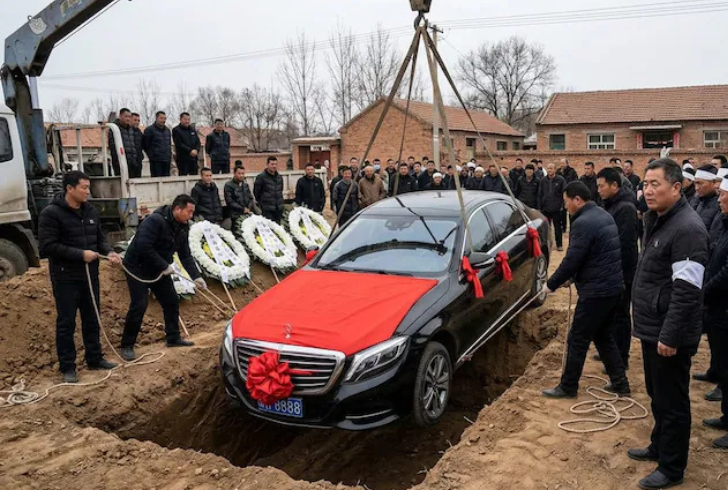
A viral video from China’s Liaoning shows a black Mercedes-Benz S450L with a “8888” license plate being lowered into a pit by an excavator and buried next to a tombstone. Local civil affairs authorities in Liaoyang say they are investigating the incident. pic.twitter.com/4LUJwGOf7L
— Shanghai Daily (@shanghaidaily) April 10, 2026
The ceremony followed a carefully arranged process. The car was wrapped in a red cloth, symbolizing good fortune, while red ribbons decorated its side mirrors. An excavator lowered the vehicle into the grave before it was covered with soil. Villagers who assisted with the burial received red envelopes containing 500 yuan (around ₹6,812) as a token of appreciation.
Adding to the spectacle, the car carried a highly valued “8888” license plate. In Chinese culture, this number is strongly linked to wealth and prosperity. Reports estimate the plate alone could be worth at least 100,000 yuan, or roughly ₹13.6 lakh.
Cultural Beliefs Behind the Decision
The family’s choice reflects long-standing Chinese funeral customs. Traditionally, people burn paper replicas of items like houses, money, and cars, believing these will serve the deceased in the afterlife. However, in this case, the family went beyond symbolic gestures by burying an actual luxury vehicle.
The decision also appears deeply personal. Reports suggest the deceased had a strong attachment to automobiles, and his children wanted to reflect his lifestyle and interests in a meaningful way. While uncommon, the act highlights how grief and tradition can intersect in unexpected ways.
Once videos of the burial surfaced online, reactions came in quickly. Many viewers criticized the act, calling it wasteful and environmentally harmful. Concerns also arose about the broader impact of such practices if they were to become more common.
At the same time, some defended the family’s actions. They viewed it as a private expression of respect rooted in cultural beliefs. The debate soon expanded, with discussions focusing on tradition versus modern responsibility, and whether personal rituals should face public scrutiny.
Government Response and Action Taken
Local authorities in Liaoning stepped in soon after the incident gained attention. Officials labeled the act as “feudal superstition” and took immediate action. The family received a formal reprimand from civil affairs authorities and was ordered to excavate the buried car.
They were also required to handle restoration and environmental cleanup costs. In addition, reports indicate the family had to issue a public apology. Authorities emphasized that such practices could violate regulations and warned against similar actions in the future.
This incident highlights the tension between cultural traditions and present-day concerns. While the family aimed to honor a loved one in a personal way, the act raised valid questions about environmental impact and social responsibility.
As traditions evolve, such moments often lead to deeper conversations about how customs can adapt without losing their meaning.